

- Fixed Retry policy - use the merchant options configuration as explained in the table below.
- Custom Flexible option - use retry decision rules for merchant-specific retry configuration such as:
- Dynamic retry interval - see Custom Retry Interval below.
- Rerouting retry attempts to different payment provider - see Custom Retry Rerouting below.
Visa category codes
- Category 1: Issuer will never approve transaction (reattempt not allowed) - Hard fail (Reject response)
- Category 2: Issuer cannot approve the transaction at this time (reattempt allowed) - Soft fail (Decline response)
- Category 3: Data Quality concern (re-validate data prior to reattempt) - Soft fail
- Category 4: Generic response code (reattempt allowed) - soft fail (Decline response)
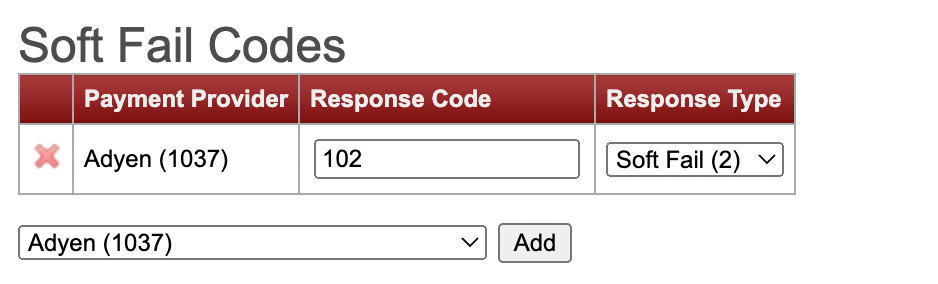
- Retry Merchant Options
-
Retry Behavior with Authorization Code Response Priority
Retry Behavior allows you to determine the order in which authorization code responses should be used. - Custom Retry Intervals
Retry Merchant Options
Following are the fixed Retry policy merchant options:
Retry Interval = Max number of retries X Retry number of days
where
Max number of retries - define in
cashbox_max_retries merchant option
Retry number of days - define in cashbox_other_retry_days merchant option
Parent topic:Retry Policy
Retry Behavior with Authorization Code Response Priority
Retry Behavior allows you to determine the order in which authorization code responses should be used.Authorization Response Codes
Vindicia receives response codes that allow us to determine whether we can retry a transaction. These response codes can come from different sources and may not always be available. Vindicia supports the following response codes:- Payment Provider Response (P) - The default response code that is used and will always be available. The specific payment provider publishes these codes as part of their integration specification. The definition of hard fail vs. soft fail is taken directly from the payment provider integration specification. We store these codes in the SML database in the table payment_provider_responses.
- Merchant Advice Code (M) - Based on Visa’s guidelines, four categories are defined for Transaction processing and described below. Accordingly, some Payment Providers are adding their own specific Merchant Advice Codes. This is a short list of responses, with values such as OK to Retry, or Do Not Retry. These codes may also be referred to as Response Code Category.
- Network Response Code (N) - These are the response codes from the credit card issuers such as Visa, MasterCard, Discover, and JCB.
401 Payment Provider Response code can sometimes return a Do Not Retry Merchant Advice Code or an Ok to retry.
Merchant Advice Codes per Payment Provider
Merchant Advice Codes can be different for each payment provider. The following is a list of the response codes available for each payment provider that supports Merchant Advice Codes.Merchant Response Code Priority
For supported Providers, merchants can set the priority order in which we consider these codes to determine if the failure is a soft fail (can be retried) or a hard fail (cannot be retried without a new payment method). The priority is set throughauth_response_priority Name/Value Pair for merchants.
The auth_response_priority Name Value Pair can be set in Subscribe Merchant Portal 1.0 using your admin account in Admin > Merchant Configurations. The order priority is read left-to-right, using the value for each type of code:
- M for Merchant Advice Code
- N for Network Response Code
- P for Payment Provider Response Code
In this example, the priority for using hard/soft failure response codes for transactions processed with Paymentech would be :
Merchant Advice Code > Network Response Code > Payment Provider Response Code
The first match determines which code type is used. If there is no response code stored on the Transaction for that code type, the next response code type in order is considered. A Payment Provider Response is always available and is used if there is not a Merchant Advice Code or Network Response Code available.
Payment Providers Supporting Auth Code Response Priority
The following payment providers support the Auth code priority feature:
Parent topic:Retry Policy
Custom Retry Intervals
These decision rules enable to modify the retry interval defined in the merchant config rules above. To understand them, first read, Configuration Method - Decision Rules. Since some banks cannot operate on weekends, we can configure the system to not retry on a weekend. Alternatively, we can configure to retry on a specific day of the week. The decision rule operates on the transaction object, and therefore can asses different values available through the transaction like:- The retry attempt number (transaction-index) - this allows you to define a different interval for the next attempt
- The retry attempt number and day - if its the forth retry and original transaction submission took place on Monday, set next attempt to 3 days. Remember: Retry 1 will be on day of submission.
- The transaction billing plan - you can set a specific retry policy per Billing plan - e.g for yearly plans try only once.
Parent topic:Retry Policy